SlowFlow | mind the space
Terminal Velocity - Prix de Rome 2026
Location: Houthaven, Amsterdam, The Netherlands
Year: February 2026
Type: Entry Prix de Rome 2026 - Spatial Research & Architectural Proposal
Services: Phenomenological Site Analysis & Atmospheric Mapping, Spatial Experience Concept Development, Spatial Analysis & Site Research, Visual Storytelling & Presentation Design
Medium: Spatial model - wood, dowels, monofilament, metal washers and granular matter on foam board base
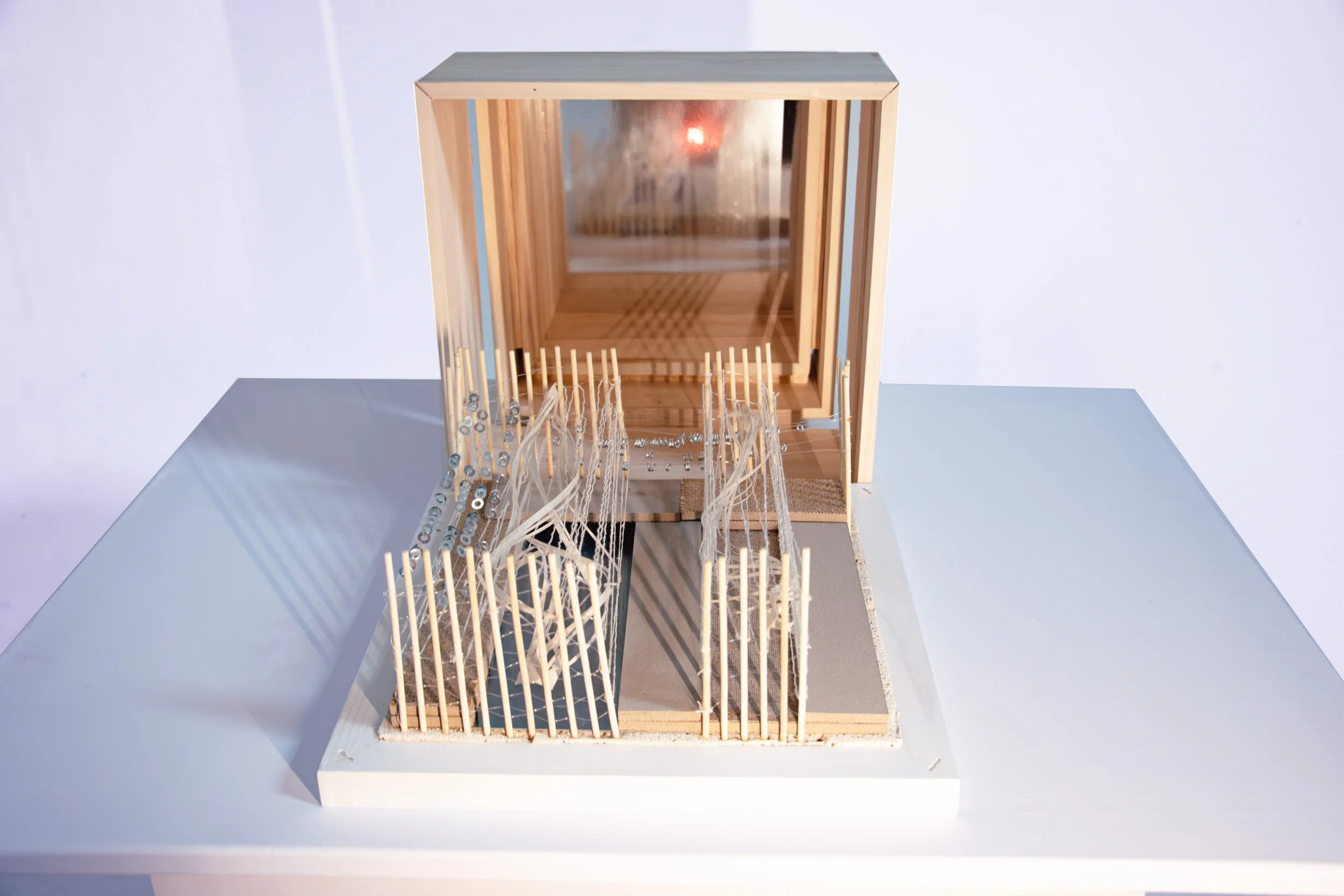
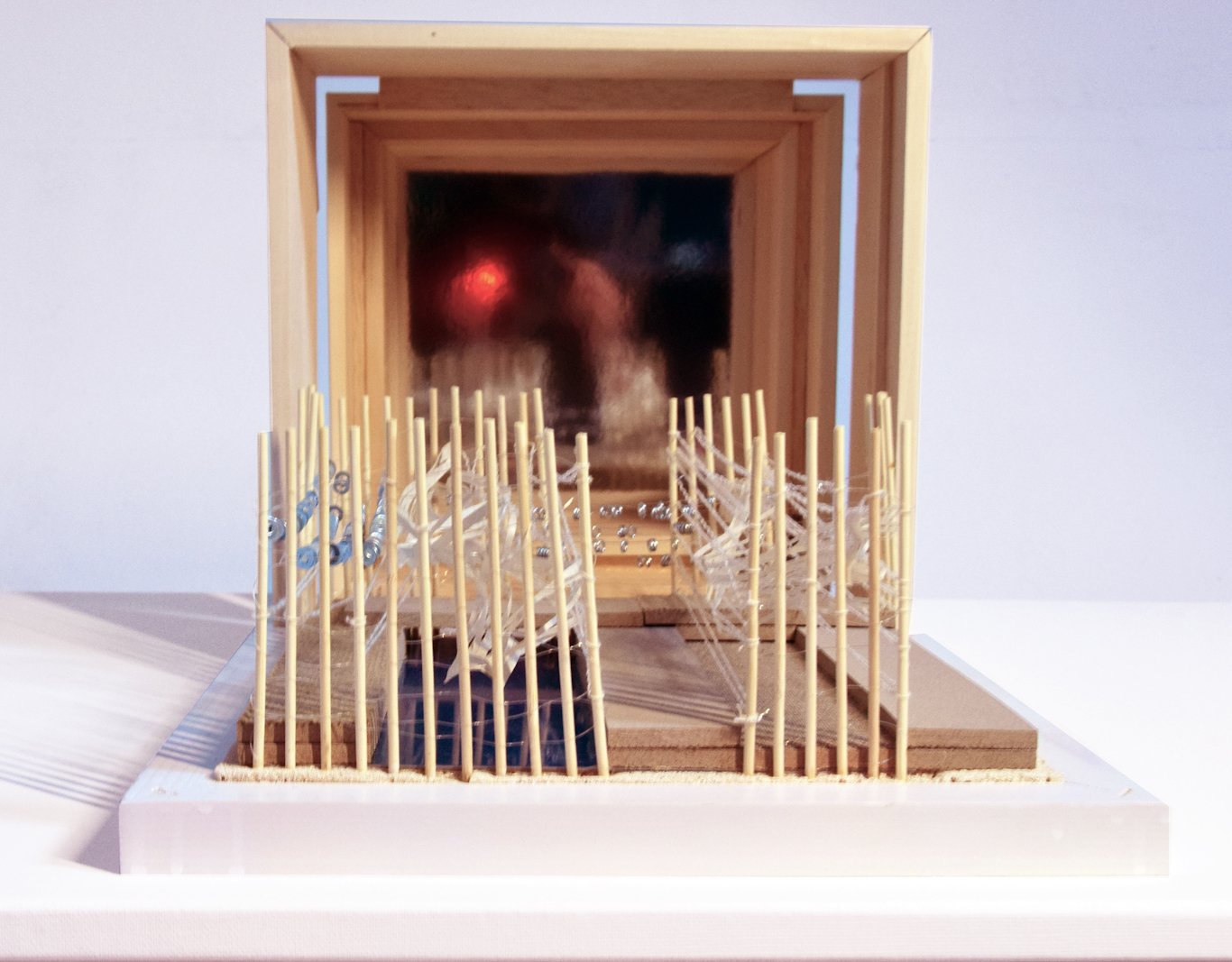
Description: A 30×30×30 cm spatial investigation instrument mapping the invisible environmental forces - wind, sound, reflection, light, that shape everyday perception in Houthaven, Amsterdam. Each material registers a force; each element makes the imperceptible tangible. Deceleration as a design methodology.
We live in a condition of accelerated reality. Cities expand faster, climate instability intensifies, ecological systems destabilize and digital saturation fragments attention. Architecture often reinforces this acceleration through speed, production and image rather than questioning its consequences.
OVERVIEW | Terminal Velocity explores the moment when acceleration reaches its limit and enters suspension. It is not collapse, but balance. Not emptiness, but potential. The project proposes deceleration as a spatial and sensory practice - an invitation to slow down and perceive the invisible environmental forces shaping everyday life.
CONCEPT | At the core of the project lies the concept of Shunya - the Sanskrit notion of “void” or “fertile emptiness.” Here, emptiness is understood not as absence, but as a generative in-between state from which meaning, form, and transformation can emerge.
The proposal investigates architecture as an interface between speed and stillness, ecological systems and human perception, atmosphere and embodiment. Rather than focusing on architecture as a static object, the project approaches space as a field of relationships shaped by environmental forces, sensory perception, and lived experience.
SITE CONTEXT | The project is situated in Houthaven, a former industrial harbor transformed through rapid urban redevelopment. The site becomes a living field of acceleration where intensified wind corridors, amplified sound reflections, fragmented water surfaces, and dense building volumes continuously reshape spatial perception.
These atmospheric conditions are not secondary effects of the urban environment; they actively define how the space is experienced. The proposal responds to this condition by examining how invisible environmental forces influence the body, movement, and awareness within the contemporary city.
METHODOLOGY | The research employs a sensory-phenomenological methodology grounded in observation, attentive listening, bodily mapping, and environmental sensing. The body becomes the primary instrument through which space is understood and interpreted.
The approach draws inspiration from the phenomenology of Maurice Merleau-Ponty, the multisensory architectural thinking of Juhani Pallasmaa, the relational systems of landscape urbanism described by Charles Waldheim, and the atmospheric sensitivity present in the work of Peter Zumthor.
Through this methodology, spatial experience is approached as temporal, relational, and embodied rather than purely visual or formal.
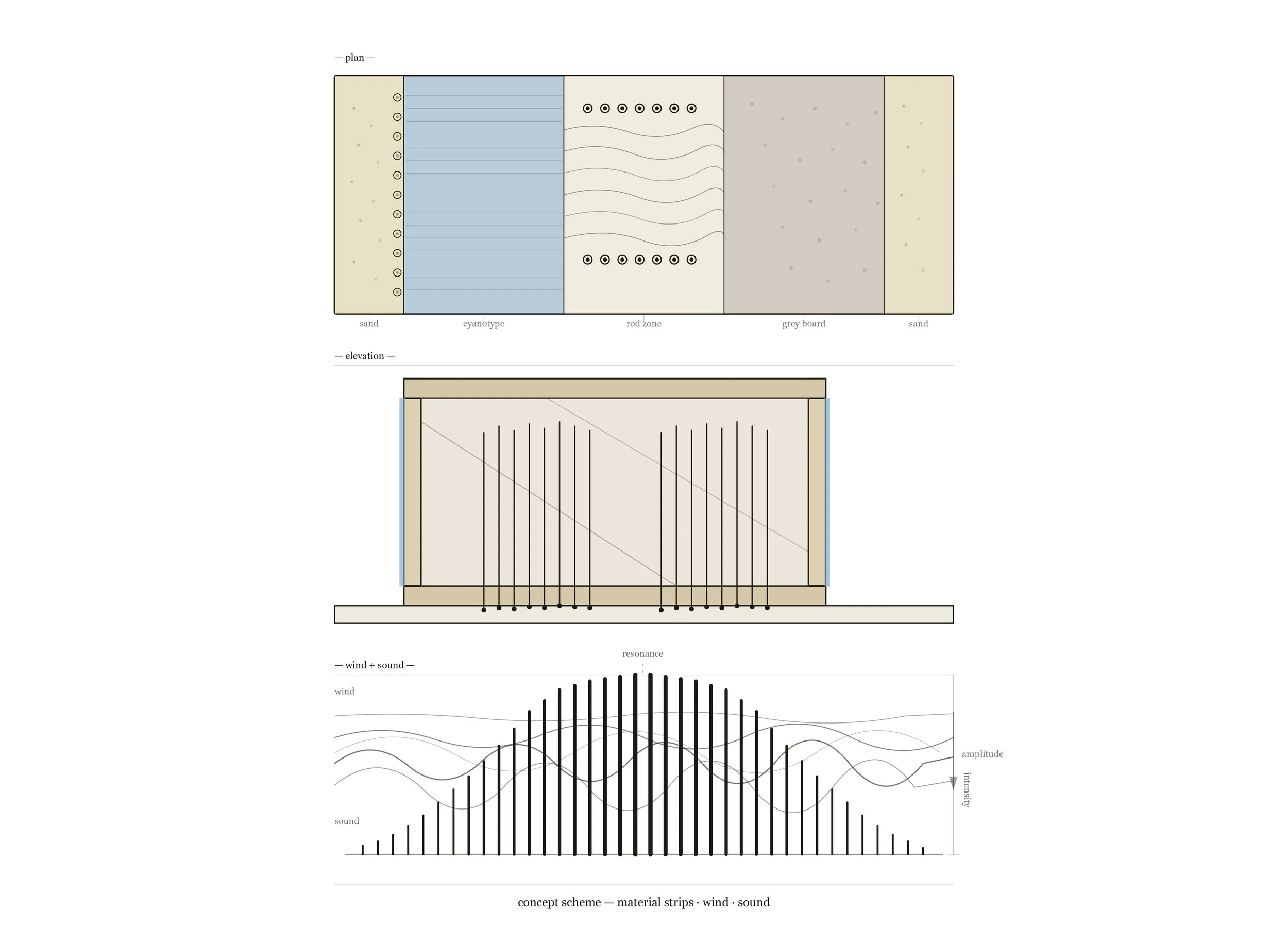
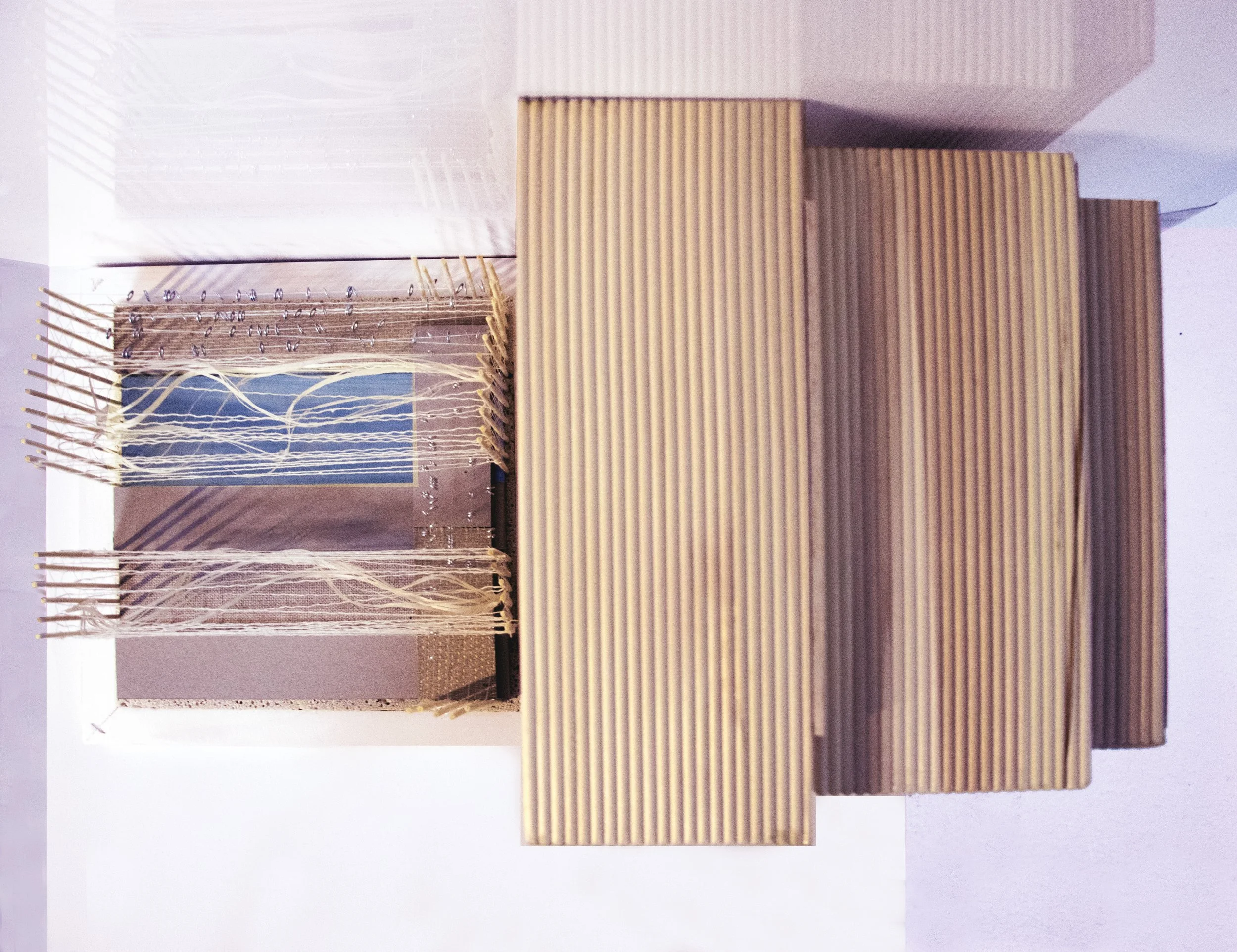
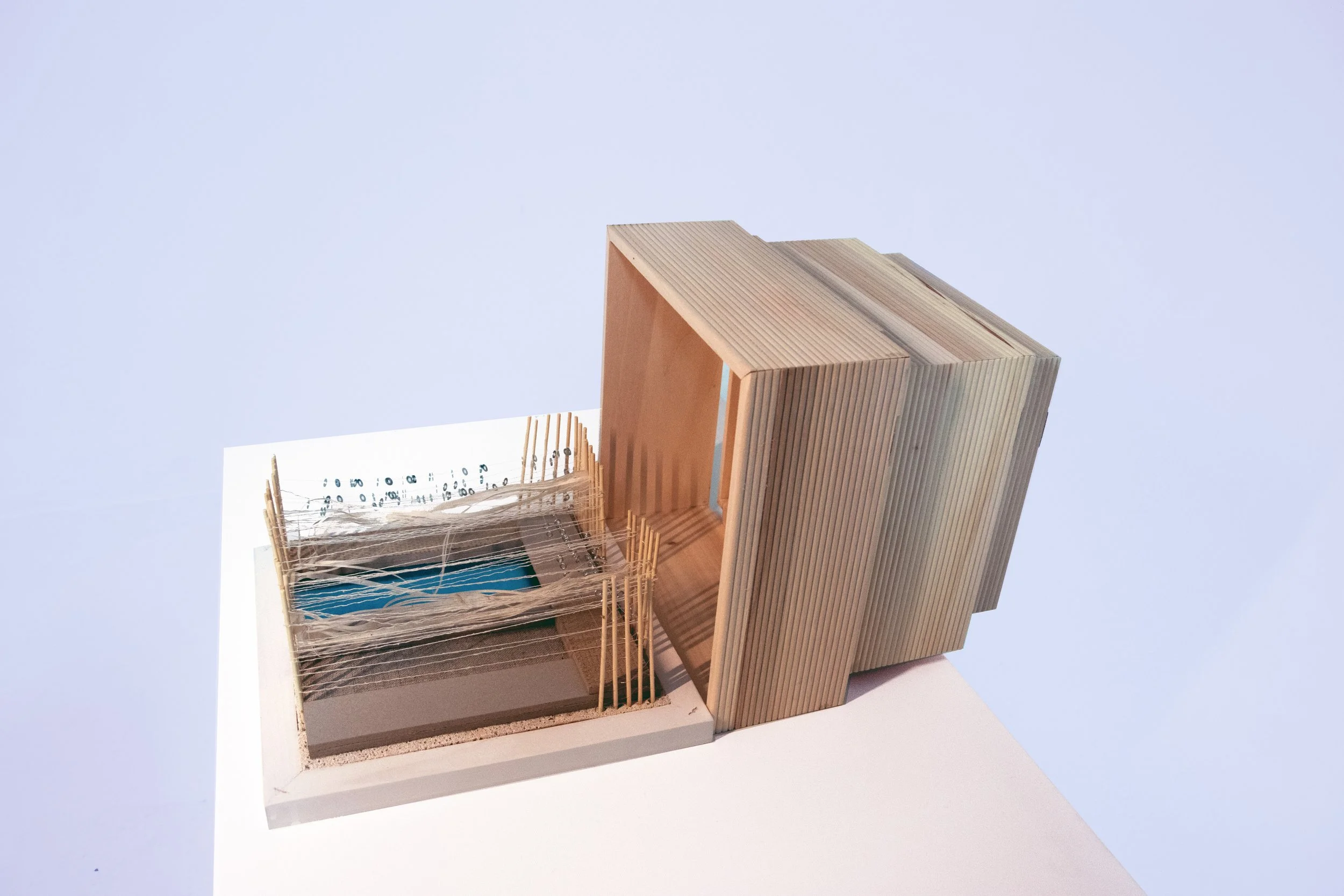
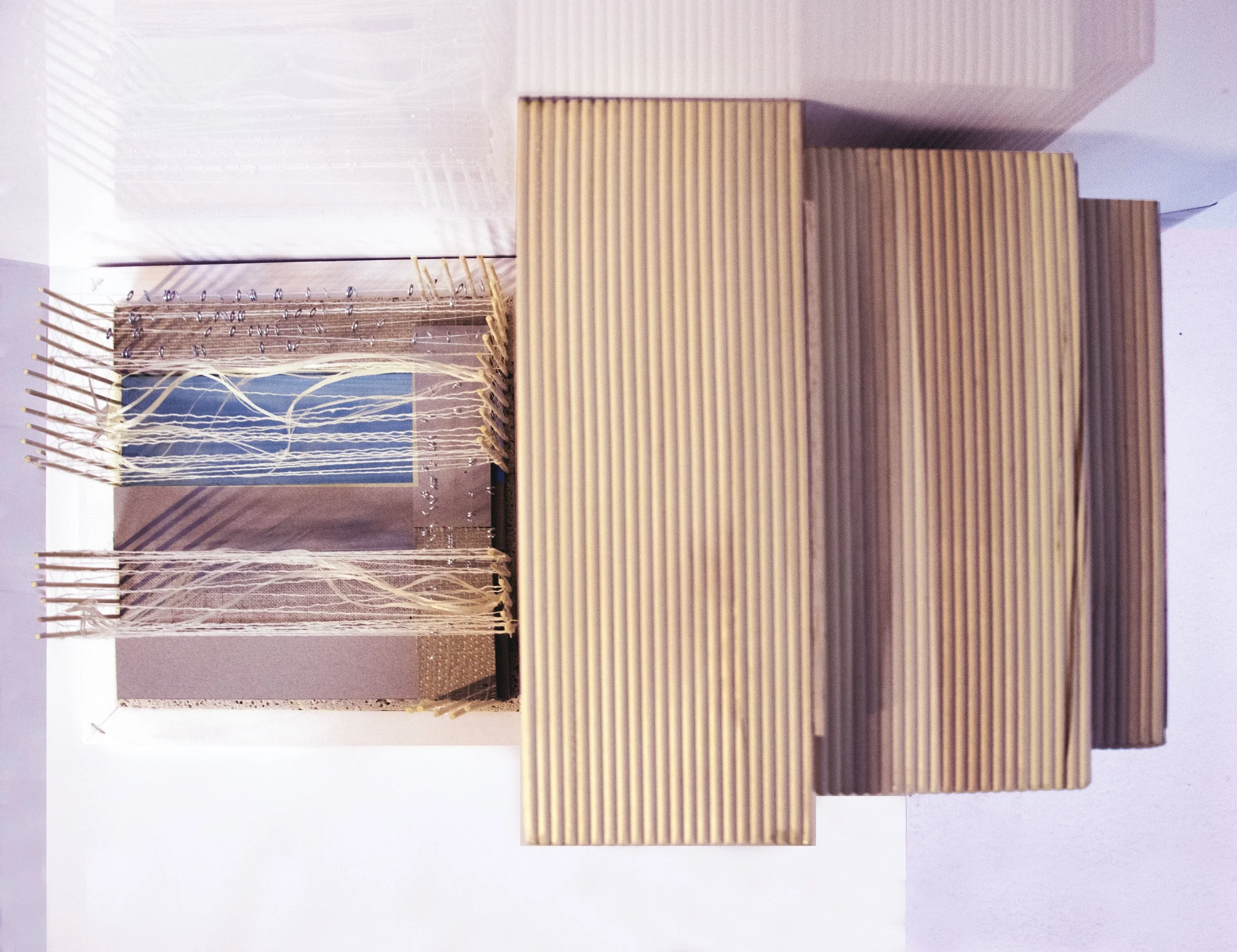
SPATIAL INSTRUMENT | The outcome is a 30 × 30 × 30 cm field model functioning not as representation, but as an investigative spatial instrument. The model translates invisible environmental forces into tangible form and reveals the atmospheric conditions shaping the site.
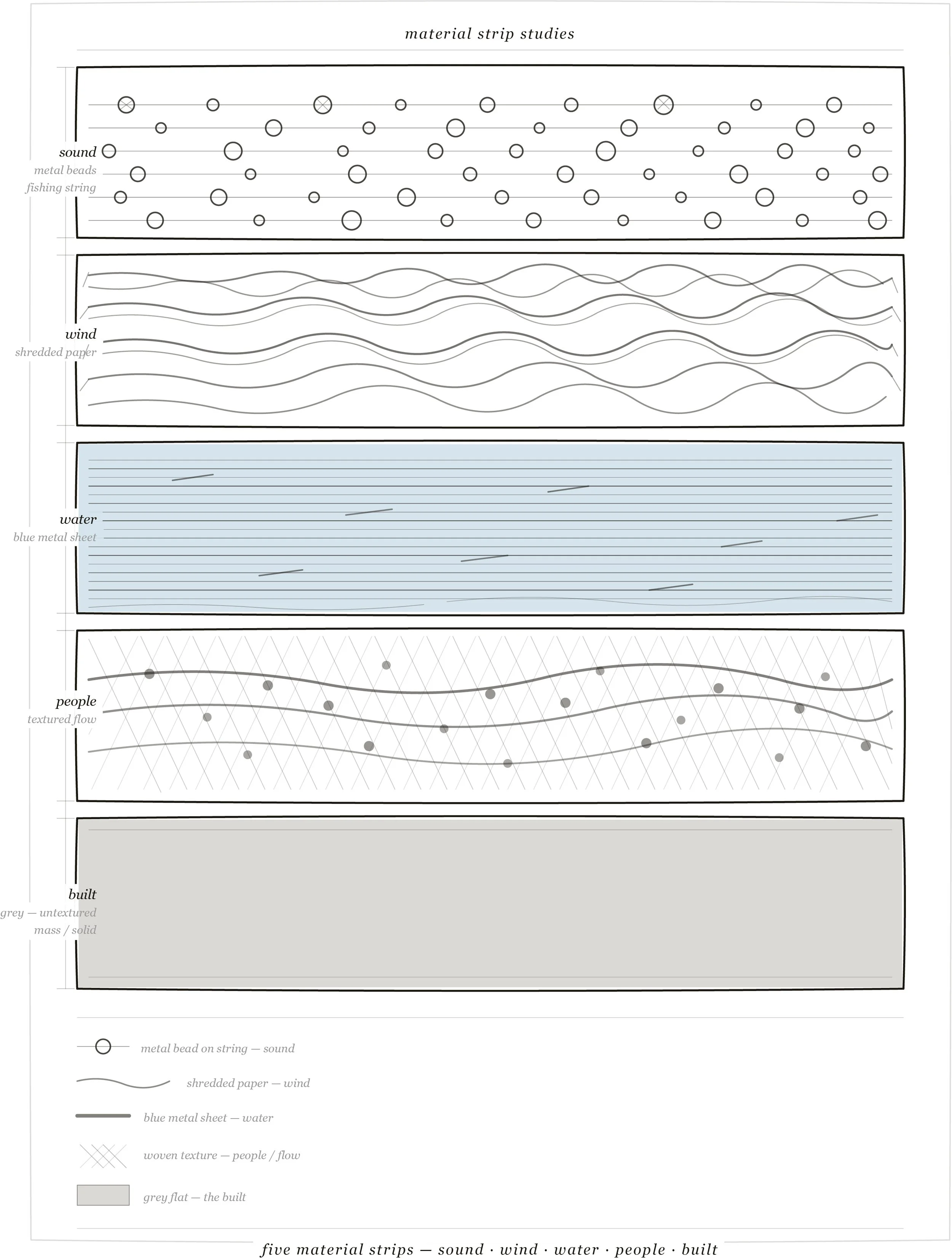
Grey material layers evoke asphalt, infrastructure, and the hardness of the built environment, while blue reflective surfaces reference water, instability, and fragmented perception. Coarse textures express accelerated movement and circulation, while finer surfaces suggest slower and more intimate spatial atmospheres.
Visually, the composition resembles a barcode, articulating transitions between public and private territories without fully enclosing them. The project emphasizes gradients, thresholds, and shifting conditions rather than fixed boundaries.
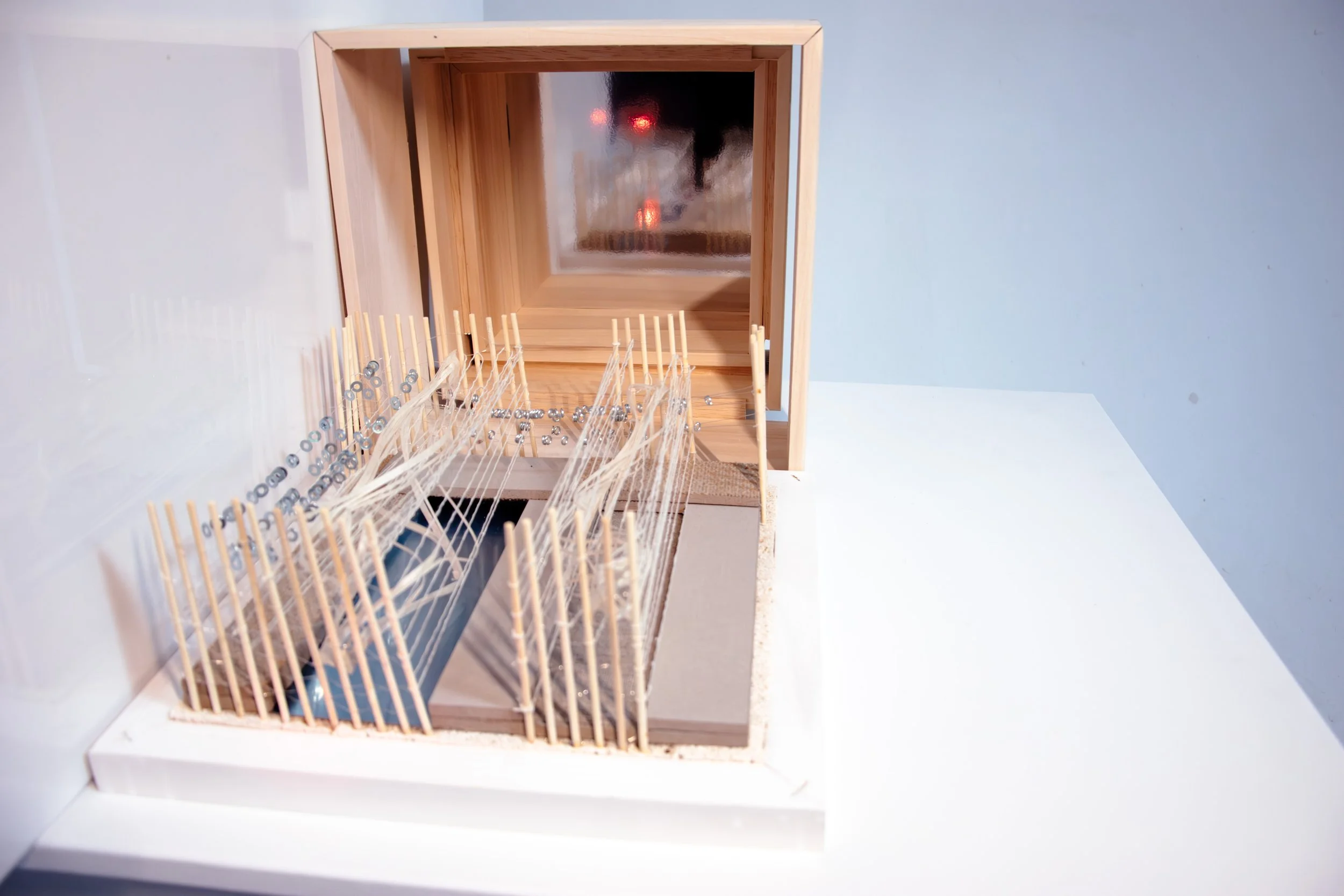
ENVIRONMENTAL FORCES | Invisible phenomena become active spatial agents within the model. Shredded paper registers wind acceleration and compression between urban volumes, while tensioned wires with suspended metal elements map acoustic gradients and vibrations. Reflective surfaces distort and fragment perception, creating unstable visual conditions.
The lid functions as a compressed echo chamber that reflects and blurs the interior landscape into a layered atmospheric image. Red light activates shifting shadows and transforms static elements into a dynamic field of tension and depth. Materials are selected not for representation alone, but for their physical behavior and ability to register environmental forces.
The project treats atmosphere not as background, but as material.
SENSITIVITY | Terminal Velocity shifts architecture away from image-driven production toward embodied spatial experience. The proposal advocates for slowing down, sensing before acting, and understanding space through the body, atmosphere, and environmental awareness.
Wind, sound, tactility, reflection, and light become design materials capable of shaping emotional and spatial perception. The project proposes a more attentive relationship between humans and their environments, where architecture operates as mediation rather than spectacle.
RELEVENCE | The project positions architecture as a scientific–artistic hybrid practice: analytical yet poetic, ecological yet sensory, experimental yet deeply human. By making invisible environmental conditions tangible, Terminal Velocity reimagines architecture as a medium for awareness, care, and collective imagination.
Rather than responding to contemporary urgencies through faster production or visual impact, the proposal argues for a slower and more sensitive approach to inhabiting the city. It invites new ways of perceiving spatial rhythms, ecological relationships, and social choreographies that often remain unnoticed within accelerated urban environments.
Ultimately, Terminal Velocity becomes a call to design not only for form, but for atmosphere, perception, reflection, and resilience.
REFERENCES |
Merleau-Ponty, M. (1945). Phénoménologie de la perception. Paris: Gallimard. (English translation: Phenomenology of Perception. 1962.London: Routledge.)
Pallasmaa, J. (2005). The Eyes of the Skin: Architecture and the Senses.
Chichester: Wiley. Waldheim, C. (2006). The Landscape Urbanism Reader. New York: Princeton Architectural Press.
Zumthor, P. (2006). Atmospheres: Architectural Environments – Surrounding Objects. Basel: Birkhäuser.